


Choosing Black Wall Lights for Deep-Coloured Walls
A black wall light against charcoal paint can be quiet in daylight. Switch it on, and the pale shade or the light falling across the wall may become its strongest feature. The fitting has two appearances to consider, and a photograph on a white background tells you relatively little about either.
Deep olive, ink blue, warm brown and burgundy each give black fittings a different backdrop. Choosing the combination means looking at the actual paint, the surface of the metal and the direction of the light together.
Take the paint sample into the room
Use a substantial paint sample and hold it vertically at the proposed light position. Include the intended paint finish, since a colour sample in another finish gives you an incomplete reference. Look at it beside the nearby timber, curtains and architectural details.
Move back to the doorway, then sit where you normally use the room. The wall may look quite different near a window from the same colour in a recessed corner. Repeat the comparison in daylight and with the room’s existing evening lights on.
When choosing wall sconces, keep a photograph of that wall with your shortlist. Include enough of the room to show the surrounding materials. A tightly cropped paint swatch leaves out the setting the fitting will eventually share.


Consider the dark framework and the pale shade separately when comparing a fitting with its wall colour.
Compare the black finish closely
Matt, satin and polished black surfaces catch light differently. A product’s colour name is only a starting point. Ask for a finish sample where available, or a close-up showing the surface in ordinary daylight.
When comparing black wall sconces, check whether the backplate, arm and shade all have the same finish. Small metallic collars, screws or a contrasting shade lining may be more visible than expected against a dark wall.
Decide how clearly you want the fitting’s outline to read. A broad disc, a fine vertical stem and a projecting shade make very different shapes. Compare those shapes against the paint sample rather than assuming that every black fitting will blend into a deep colour.
If there is existing black metal nearby, such as a window frame or door handle, compare the surfaces together. They can relate through colour while retaining different textures. Close-up photographs help you spot differences that a small product thumbnail hides.
Look at the light pattern after dark
The direction of the light changes the composition. An upward wash draws attention to the wall above the fitting. A downward-facing shade concentrates the effect elsewhere. An exposed bulb becomes a visible element in its own right.


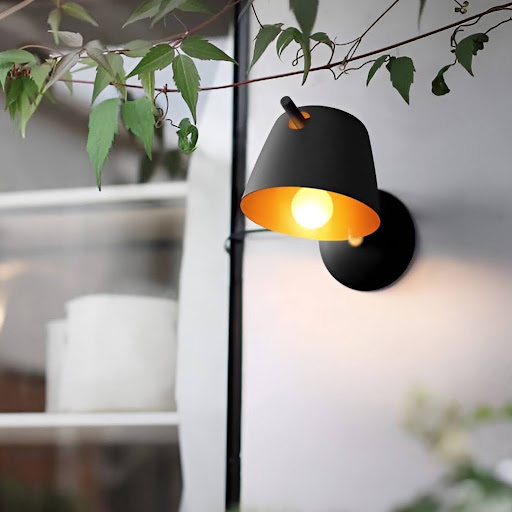
A contrasting shade interior and a visible bulb contribute colour and shape when the light is switched on.
Ask for illuminated photographs of the exact version you are considering. Look for a view that shows the surrounding wall, as well as one showing the fitting itself. Product photography is useful for understanding the design; the effect in your room will also depend on its surfaces and other lights.
Pay particular attention to texture. Light directed across plaster, brickwork or decorative panels can make surface detail more noticeable. Compare an example using a similar surface, or arrange a suitable sample test with the lighting supplier where possible.
Keep the practical purpose in view. A decorative wash behind a sofa and light for reading beside an armchair are separate requirements. Establish which one you need before choosing the shade opening, light source and adjustment options.
Check the view from the nearest chair as well as from standing height. An open shade may expose the bulb to a seated person. Ask for a view of the shade opening, and confirm how any adjustable arm or head moves before assuming the light can be aimed elsewhere.
Give the fitting a deliberate position
On a coloured wall, the backplate becomes part of the arrangement alongside artwork, furniture and mouldings. Make a paper outline using the complete fitting dimensions and hold it against the wall. Include any arm or shade extending beyond the backplate.
Look at the outline beside picture frames and panel edges. Check the view from across the room and from the nearest seat. A pair of fittings needs this same exercise on both sides, especially where the wall or furniture arrangement is uneven.
For a plug-in design, include the cord and its route to the socket in the arrangement. The cable may remain visible against the paint even when the fitting itself blends into it. Decide how that line will sit beside the furniture.
For fixed wiring, have the installer assess the proposed position before the wall finish is completed. Include the fitting’s projection and the movement of nearby doors or curtains in that discussion.
Confirm the version you are ordering
Keep the selected finish, dimensions, light source and control method together. Confirm whether bulbs are included and how any dimming operates. For an imported fitting, ask the supplier and local installer to confirm its electrical suitability for the project location before ordering.
Record the paint colour and finish alongside those details. If the decorating and electrical work are separate packages, agree who will prepare and finish the wall around the mounting point. That conversation is easier while the paint is still a sample and the light is still on the shortlist.







You might also like...
-
Mash.T Axis Collection: Sculptural Lighting & Furniture Design

At Mash.T Design Studio, design begins not with a finished object, but with process, experimentation, and the discipline of making. The studio’s latest release, Axis, ...
-
Jozi Lighting Opens the Door to a New Era of Architectural Lighting

Lighting has the power to transform a space, shaping not only how it looks, but also how it feels and functions. As one of South ...
-
The Handmade Story: Perfectly Imperfect Ceramic Lighting from South Africa

There is something particularly special about lighting that still carries the mark of the person who made it. A fingerprint in the clay, a ...
-
Glass Lighting Trends | Timeless Elegance by The Lighting Warehouse

In the ever-evolving world of interior design, few elements possess the timeless appeal and versatility of glass lighting. Celebrated for its ability to reflect, refract ...


Visit SA Decor & Design on social media


